World Heritage Sites

Chaukandi Tombs
Heritage Sites in Pakistan, Islamic Heritage, Monuments, Sindh, Tombs, World Heritage Sites

Chaukandi Tombs

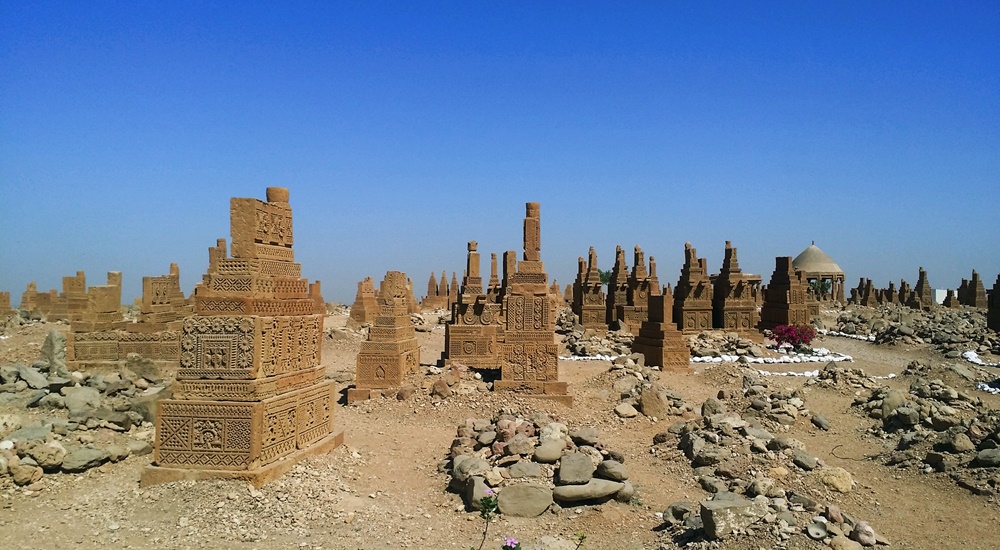
Expanding across a two-square-mile area, the Chaukandi Tombs near Karachi form an ancient Islamic burial site. The Chaukandi Tombs are renowned for its detailed sandstone carvings. These tombs bear a stylistic similarity to the elaborate graves located at the Makli Necropolis, one of the six UNESCO World Heritage Sites, near Thatta. Displaying the distinctive funerary architectural style typical of lower Sindh, the Chaukhandi Tombs undoubtedly provide a fascinating insight into the historical and artistic legacy of the region. History of Chaukandi Tombs: The Chaukhandi graveyard is attributed to the Jokhio tribe of Sindh. At the same time, other Sindhi tribes like Burfat, Jakhra, and Shaikh tombs are also found. The graveyard was constructed during the Mughal rule from the 15th to the 18th century, a period dominated by Islam. In addition to the Jokhio tribe, various Baloch tribes with Rajput origins have found their final resting place here. The influence of the Rajput tribe is evident in the design of the tombs. The step-shaped graves basically showcase a blend of cultures. For instance, some graves feature Rajput characteristics like monumental pedestals and slabs, while others exhibit simpler decorations, resembling a child’s drawing of a human face. Likewise, some tombs lack any human figures, reflecting Islamic beliefs and contributing to the diverse historical tapestry preserved in the Chaukhandi necropolis. The majority of the tombs at Chaukhandi especially represent family graveyards. However, only a limited number placed beneath pillar canopies that exhibit a Hindu architectural style. On certain male graves, intricate carvings depict a horseman equipped with arms such as a shield, sword, bow, and arrow. Meanwhile, carvings on women’s graves portray ornamental details like bracelets, necklaces, rings, anklets, and more. Additionally, for male graves, a boss-shaped projection at the northern end is designed to secure the turban of the deceased. These detailed carvings provide insights into the cultural and personal attributes of the individuals interred at Chaukhandi. Design of Chaukandi Tombs: The tombs at Chaukhandi stand out as a distinctive illustration of surface burials. Unusually aligned from south to north, a departure from the norm in both the region and period, these tombs are crafted from substantial sandstone slabs intricately arranged to form refined pyramid shapes. The meticulous carving on these slabs showcases intricate patterns, drawings, and scenes that contribute to the unique artistic and historical significance of the Chaukhandi Tombs. The absence of precise dating inscriptions on the Chaukhandi Tombs makes it challenging to determine their exact historical timelines. A typical casket consists of six vertical slabs, with two placed at the head and foot of the grave and the remaining four covering the sides, accommodating the length of the body. The tomb takes on a pyramid-like shape, featuring six large slabs covered by another tomb comprising six smaller vertical slabs. The architecture of Chaukandi Tombs: These tombs explicitly represent a unique blend of Sindhi and Balochi architectural styles. Crafted from beige-colored sandstone, these tombs come in the form of single graves or clusters, containing up to eight tombs. Despite the challenges posed by the region’s arid climate, these tombs have endured, serving as a resilient testament to the culture and heritage of the area. Chaukhandi Tombs, a form of funerary architecture, are characterized by square-shaped structures. Its five horizontal slabs enclosing the upper part of the tomb. Notably, these structures often exhibit a carved knob resembling a crown or turban at the front. Graves of warriors from the tribe boast intricate designs and motifs, including depictions of horsemen, jewelry, and hunting scenes. In contrast, tombs of women showcase carvings of anklets, bracelets, and jewelry at the front rather than human figures. Men’s graves typically feature carvings of swords, symbolizing their role as protectors of the tribe during times of war. Distinctive Features of Chaukandi Tombs: The Chaukhandi Tombs exhibit several distinctive features: The most prominent visual characteristic of Chaukhandi tombs is their cone-shaped roofs, constructed using bricks or stones and mortar. This design choice was made to distribute the weight of the structure over a larger area, enhancing stability and durability. The walls of Chaukhandi tombs are built in a beehive formation. The tombs feature multiple layers of stones arranged in a stepped pyramid shape. Constructed from local stones and bricks, these walls often bear decorative designs. Inside each tomb, there is typically a dedicated prayer chamber. This space actually serves for mourning and remembrance of the departed. Accompanying every tomb is a raised grave platform, situated above the surrounding landscape. This platform serves as a place for the family of the deceased to conduct rituals related to the burial. Discovery of Chaukandi Tombs: The Chaukhandi Tombs gained historical recognition with the earliest reference found in a letter written by J. Macleod, a Scottish historian, to Sir Henry Bartle Edward Frere, a British administrator, in 1851. However, it was H. D. Baskerville, the Assistant Collector of Thatta in Karachi in 1917, who brought these historical graves into prominence. In 1922, the site was officially included in the Ancient Monuments Preservation Act. Jean Philippe Vogel, a distinguished Dutch epigraphist employed by the Archaeological Survey of India from 1901 to 1914, played a crucial role in shedding light on the tombs. His extensive research revealed that many of these tombs belonged to Muslims. It was evident from the Arab script inscribed on their graves. Vogel’s findings provided valuable historical insights into the religious heritage of India. Post-independence, scholars and historians continued their in-depth investigations into the Chaukhandi Tombs. Rubbings of these tombs were displayed globally, capturing the attention of academics and sparking further research into this significant archaeological site. Recommendations: Chaukhandi Tombs are highly recommended to visit for individuals passionate about archaeology and history. The site holds a wealth of historical narratives. If you’re intrigued, plan your visit to this amazing site. Apart from the rich decoration adorning the tombs, another noteworthy aspect shared with similar necropolises worldwide is the prevalent local belief that the area is haunted. The Chaukhandi Tombs are reputed to be one of the most haunted sites in the
Tentative list of UNESCO World Heritage Sites of Pakistan
Blogs, Heritage Sites in Pakistan, World Heritage Sites

Tentative List of UNESCO World Heritage Sites of Pakistan

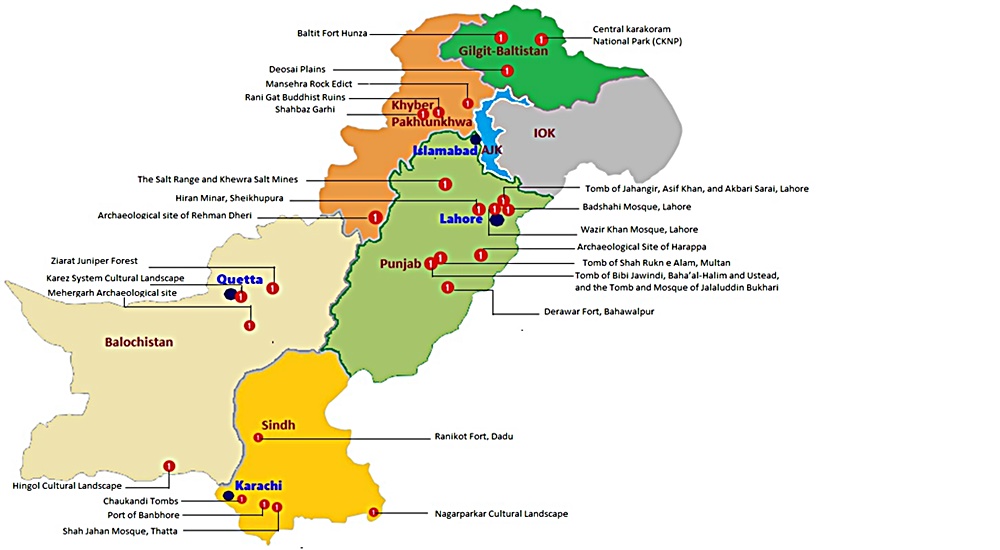
Tentative List of UNESCO World Heritage Sites of Pakistan Pakistan boasts six UNESCO World Heritage Sites. In addition to these established sites, the country has compiled a roster of 25 potential sites called the Tentative List of UNESCO World Heritage Sites of Pakistan seeking recognition. This catalog has been formally presented to the UNESCO Committee for assessment and approval. The pre-listing process is a mandatory step for the eventual acceptance of nominations onto the esteemed World Heritage list. Punjab Province The Salt Range and Khewra Salt Mine The Salt Range, rising abruptly from the Punjab plains in Pakistan, spans 180 km and features sheer escarpments, jagged peaks, and fertile valleys. Originating 800 million years ago, it formed from the evaporation of a shallow sea and underthrusting of the Indian Plate. Named for the thickest rock salt seams globally, the range is a geological treasure with fossiliferous stratified rocks and exposed strata, attracting global geologists. The region is rich in paleontological finds, including dinosaur trackways, Cretaceous belemnites, and ancient hominid remains. The Salt Range is a historical and cultural hub with sites dating from Alexander the Great‘s era to the British colonial period. Notably, Khewra hosts one of the world’s richest salt deposits, exploited for over a millennium, continuing as a mining, research, and tourism center. Badshahi Mosque, Lahore The Badshahi Mosque and its expansive courtyard are elevated on a platform accessible from the east via a grand staircase and a traditional Mughal-style gateway. The entrance, a two-story structure, boasts intricate decorations with framed and carved paneling on all facades. Square minarets with pseudo-pavilions in red sandstone and white marble cupolas adorn the four corners. Its tall octagonal minarets are positioned at the courtyard’s corners. Additionally, smaller octagonal minarets are attached to the prayer chamber’s corners, beneath three grand marble domes. The red sandstone exterior is subtly adorned with white marble inlay lines and patterns. The interior and exterior of the prayer chamber feature unique and beautifully crafted Zanjira interlacing and floral motifs in bold relief, showcasing unparalleled beauty and craftsmanship in Mughal architecture. The gateway’s inscription indicates its construction in A.H. 1084 (1673-74 A.D.). Wazir Khan Mosque, Lahore The Wazir Khan Mosque, covering an area of 279′ x 159′, is entirely constructed using cut and dressed bricks laid in kankar lime, with minimal use of red sandstone in the gate and transept. The courtyard is split into two sections, with the upper part slightly elevated and an ablution tank in the middle. Flanking the east, north, and south sides of the courtyard are 32 small hujras of varying sizes. The prayer chamber on the west side features five compartments divided by massive piers supporting wide, four-centered arches, each topped with a dome. Small rooms are created at the northern and southern ends, and an eastern gallery leads to a spiral staircase accessing the roof. Distinctive structural elements include four corner minarets, five domes, and a transept at the entrance gate on the east. According to inscriptions, the mosque was built in A.H. Archaeological Site of Harappa The archaeological site of Harappa, extending over 150 hectares, comprises eight mounds and two cemeteries situated to the south of the dry Ravi riverbed. While much of the site is buried beneath agricultural land or the modern village of Harappa, exposed structures on mounds AB and F date back to the third millennium BC. The site’s sequence spans from the fourth to the second millennium BC, with a depth of over 13 meters. The strategic location beside the old course of the Ravi River granted inhabitants access to trade networks, aquatic resources, and water for cultivation, explaining its prolonged occupation. Harappa’s town plan during the mature Harappan period (2600-1900 BC) features self-contained walled centers on raised mounds. The site’s unique urbanization declined in the second millennium BC, and subsequent developments, including brick removal for railway ballast in the 1850s and salination from irrigation agriculture, impacted the preservation of structures. Tombs of Jahangir, Asif Khan and Akbari Sarai, Lahore The Tombs of Jahangir, Asif Khan, and Akbari Sarai, designated on December 14, 1993, showcase remarkable Mughal architecture. Jahangir’s Tomb is a single-story structure with a square plan, featuring tall octagonal corner towers and a projecting entrance bay on each side. The exterior boasts red sandstone facing with intricate marble inlay decoration. The interior displays floral frescoes, delicate inlay work (pietra dura), and vibrant marble intersia. Asif Khan’s Tomb, an octagonal structure with a high bulbous dome, stands in a vast garden. Originally adorned with rich stone inlay and bold stucco tracery inside, it featured a high bulbous double dome covered with marble veneering. Akbari Sarai, between Jahangir and Asif Khan’s, includes an open courtyard with small cells, adorned gateways, and a mosque with three splendid domes. The Sarai and the entrance gateway seem part of a unified complex from Shah Jahan’s era, sharing similar styles and elements. Hiran Minar and Tank, Sheikhupura The Hiran Minar, erected under Emperor Jahangir’s reign in 1620 AD, boasts unique architectural elements. Its facade sports 210 square perforations arranged in 14 rows, while inside, a spiral staircase with 108 steps leads to the top, adorned with 11 rectangular arched openings. Divided into six tiers, the Minar showcases lime plaster possibly embellished with floral or linear frescoes. An arched entrance graces the lowest tier. Across from it lies a rectangular tank connected by a causeway to an octagonal baradari. Each corner features square pavilions with gateways. The tank, equipped with ramps, parapet walls, and staircases, connects to the Aik rivulet via a channel. Inside the baradari, intricately decorated niches and honeycomb patterns adorn the walls. The causeway, supported by 21 pointed arched pillars, links the main baradari to an octagonal platform in the tank’s center, which served as a royal residence. Tomb of Hazrat Rukn-e-Alam, Multan The tomb of Shah Rukn-i-Alam, constructed between 1320 and 1324 AD by the Tughluq ruler Ghiyas-ud-din, was initially meant for his dynasty but later dedicated to the family of the revered Sufi saint. This

Lahore Fort and Shalimar Garden
Heritage Sites in Pakistan, Islamic Heritage, Punjab, World Heritage Sites

Lahore Fort and Shalimar Garden

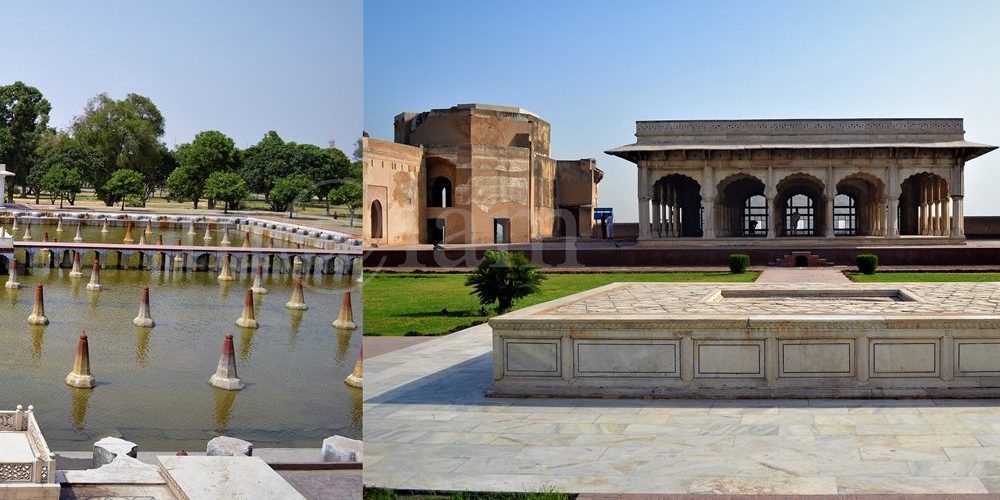
Exploring Lahore’s Magnificent Lahore Fort and Shalimar Garden: A Glimpse into Mughal Grandeur Lahore, the cultural heart of Pakistan, boasts two magnificent Mughal-era treasures: the Lahore Fort and Shalimar Garden. These architectural marvels continue to stand as symbols of pride and prestige in Lahore, having earned their rightful place as UNESCO World Heritage Sites of Pakistan in 1981, owing to their remarkable collection of Mughal monuments that epitomize the artistic and aesthetic zenith of the empire. The fort is located at the northwest corner of the walled city of Lahore while the Shalimar Gardens are situated along the Grand Trunk Road some 5 kilometers northeast of the main Lahore city. The monuments are located at a distance of 7 kilometers from each other. Dating back to 1the 7th century, both masterpieces reflect the true artistic expression of the Mughals at its peak.  The fort is the only monument that represents the complete history of Mughal architecture in Pakistan. The Shalimar garden, built by Emperor Shah Jahan in 1642, still retains the glorious Persian and Islamic tradition is a fine example of Mughal gardens. Lahore Fort: A Historical Marvel The Lahore Fort, also known as Shahi Qila, sprawls across an impressive 20 hectares. This irregularly designed citadel features 21 notable monuments, some dating back to the reign of Emperor Akbar. In the 17th century, during the peak of the Mughal Empire, the fort underwent extensive reconstruction. Its origins can be traced back to 1566 when Emperor Akbar laid the foundations for the modern Lahore Fort. Interestingly, the fort’s architectural design seamlessly blends Islamic and Hindu motifs, a testament to its rich history. As time passed, subsequent Mughal Emperors made alterations to the fort. Following the decline of the Mughal Empire, it served as the residence of Ranjit Singh, the founder of the Sikh Empire. Later, the British made significant modifications to suit their needs. Shalimar Garden: A Natural Paradise The Shalimar Gardens in Lahore represent an exceptional Mughal garden complex, seamlessly merging natural beauty with architectural grandeur. Commissioned by Emperor Shah Jahan in 1641, these gardens were completed in 1642, showcasing the pinnacle of Mughal artistry. Encompassing 16 hectares, the garden’s rectangular layout is enclosed by crenelated walls constructed from red sandstone. It is divided into three terraces, each with its own distinctive name. The upper terrace is named “Farah Baksh” (Bestower of Pleasure), the middle terrace “Faiz Baksh” (Bestower of Goodness), and the lower terrace “Hayat Baksh” (Bestower of Life). One of the most remarkable features of the Shalimar Gardens is its intricate water circulation system, comprising 410 fountains. These fountains, distributed throughout the three terraces, create a mesmerizing spectacle. The garden’s thermal engineering was designed to provide cooling relief to visitors during scorching summers, a feat that continues to baffle scientists today. While initially intended to entertain royal guests, a specific section of the Shalimar Gardens was open to the general public. Located just 5 kilometers northeast of Lahore’s city center, the garden’s land originally belonged to the Arian Mian Family. In recognition of their contributions to the Mughal Empire, Emperor Shah Jahan bestowed upon them the prestigious Mian title. The Lahore Fort and Shalimar Garden stand as enduring testaments to the Mughal Empire’s architectural and artistic brilliance. Their historical significance and timeless beauty continue to captivate visitors, making them indispensable landmarks in Lahore’s rich cultural heritage.

Makli Necropolis
City Breaks, Heritage Sites in Pakistan, Monuments, Sindh, Tombs, World Heritage Sites

Makli Necropolis

Unveiling the Enigma: Makli Necropolis – A Treasure Trove of History and Artistry Nestled in a diamond-shaped expanse, the grandeur of the Makli Necropolis in Thatta is unparalleled. It boasts of its status as one of the largest graveyards globally covering a sprawling 10 square kilometers. Altogether, the Makli Necropolis houses an astonishing half-million monuments. The graveyard stands as the final resting place for an eclectic mix of individuals, from regal monarchs and erudite scholars to valiant warriors, philosophers, governors, and revered saints. In recognition of its historical significance, Makli Necropolis, therefore, earned its place among the UNESCO World Heritage Sites of Pakistan in 1981. A Journey Through Time: Unraveling the History of Makli Necropolis Delving into the annals of history, Makli Necropolis emerges as the eternal abode for over 125,000 saints. Throughout the ages, this city has undeniably been a beacon of knowledge housing around 400 educational institutions. Here students from the Muslim world and Asia came to hone their skills. Students generally engaged in a diverse array of subjects encompassing religion, politics, and philosophy.  Yet, the enigmatic origins of Makli remain shrouded in mystery. It is widely believed that the cemetery evolved around the shrine of the 14th-century Sufi Hamad Jamali. As for the etymology of “Makli,” two intriguing notions persist. Locals suggest that it signifies “Mecca-like,” while another legend ties it to the pious woman known as “Mai Makli.” Legend has it that her fervent prayers thwarted Sultan Firuz Shah Tughlaq’s conquest of Thatta until her passing. She now rests in Makli near the tomb of Jam Nizamuddin. Thatta enjoyed a glorious stint as the capital of Sindh from the 14th to the 18th centuries. Initially, it was ruled by three successive dynasties – Samma, Argun, and Tarkhan. However, it later came under the dominion of the Mughal emperors of Delhi from 1592 to 1739 before being ceded to Shah Nadir of Iran, marking the beginning of a period marked by decline and neglect. The Architectural Marvels of Makli Necropolis The monuments of Makli Necropolis are a testament to the social and political history of Sindh from the 14th to the 18th centuries. Crafted with exquisite architectural finesse, these tombs and graves epitomize the artistic prowess of their time. The tombs were built by utilizing an array of materials such as sand bricks, stone, and marble. Some of these monuments are opulently adorned with glazed tiles, boasting intricate designs, arched domes, and towers adorned with exquisite Islamic calligraphy and devotional carvings inspired by diverse religious and iconographic traditions. Remarkably, many of these iconic monuments have withstood the test of time, enduring centuries of exposure to the elements. However, preserving this rich heritage for future generations necessitates substantial restoration efforts. Makli Necropolis: A Journey Through Location and Access Situated adjacent to the tip of the Indus River delta, Makli Necropolis lies on the outskirts of Thatta.  It was an ancient bastion of Islamic civilization nestled at the edge of the 6.5-kilometer-long plateau of Makli. This historic site is located approximately 89 kilometers east of Karachi in the Sindh province of southern Pakistan. Makli offers an ideal day trip from the bustling metropolis of Karachi. Navigating the vast expanse of the graveyard is made convenient through its wide streets, ensuring access to all the awe-inspiring monuments. Makli Necropolis undoubtedly stands as a testament to the rich tapestry of history, culture, and artistry. The graveyard has woven itself into the very fabric of this remarkable site. It beckons not only to history enthusiasts but also to travelers, both domestic and international, and devout pilgrims alike, offering a glimpse into an enigmatic past that continues to captivate our imaginations.

Mohenjo-daro UNESCO World Heritage Site in Sindh
Archaeological sites, Sindh, World Heritage Sites

Mohenjo-Daro

Unlocking the Enigma of Mohenjo-Daro: A Dive into Ancient History Mohenjo-Daro also spelled as Mohenjodaro or Moenjodaro, holds a mystique as intriguing as its name, which translates to “Mound of the Dead.” This archaeological gem is nestled in the Sindh province of Pakistan, offering a window into the enigmatic Indus Valley Civilization (IVC) that thrived around 2600 BC. Mohenjo-Daro is one of the six UNESCO World Heritage Sites in Pakistan inscribed in 1980. The city’s original name remains a mystery. The Dawn of Civilization Our story begins around 5500 B.C. when a nomadic tribe settled in the villages west of the lower Indus River. These early settlers, adapting to their environment, mastered tools, constructed humble dwellings, cultivated crops, and tamed animals. Over centuries, as climate patterns evolved, lush jungles and thriving wildlife emerged. Gradually, this nascent community expanded both in size and influence, engaging in trade with regions as distant as Central Asia and the neighboring western territories. By 2600 BC, Mohenjo-Daro evolved into a civilization rivaling the sophistication of Mesopotamia and Egypt. Unveiling the Indus Valley Civilization The Indus Valley Civilization, also known as the Harappan Civilization, boasted two major cities, Harappa and Mohenjo-Daro, along with over 100 smaller settlements. It marked the dawn of urbanization in the Indian subcontinent. From 2600 B.C. to 1700 B.C., this civilization thrived on the fertile plains along the Indus River, showcasing remarkable literacy with a unique script consisting of 250-500 Dravidian characters. This civilization stands tall among the world’s great ancient cultures, with its initial discovery at Harappa in 1921, followed by Mohenjo-Daro in 1922. Rediscovery and Archaeological Endeavors The journey to resurrect Mohenjo-Daro’s glory began in 1922 when R.D. Banerji, an archaeologist with the Archaeological Survey of India, stumbled upon the site. A series of extensive excavations, overseen by renowned archaeologists, occurred until the 1930s. Later, in 1964-65, brief excavations resumed, only to be halted due to preservation challenges. Mohenjo-Daro’s sprawling ruins, stretching across approximately 750 acres, housed a peak population of around 40,000, making it one of the world’s largest and most advanced cities in its era. The city’s construction, characterized by unbaked bricks atop elevated mounds, exemplifies meticulous town planning principles. Urban Planning and Infrastructure Mohenjo-Daro’s urban layout followed a structured grid, with rectilinear buildings dominating the landscape. Most structures were constructed using standardized fired and mortared bricks, complemented by evidence of sun-dried bricks and wooden superstructures. The city comprised two main sections: the Citadel, standing 12 meters high and featuring two grand assembly halls and public baths, likely reserved for religious ceremonies, and the Lower City, comprising courtyard houses for the middle class. These houses featured brick stairs leading to flat roofs and small bathrooms equipped with drains and sanitation facilities. The Magnificent Great Bath A crowning jewel among Mohenjo-Daro’s structures is the Great Bath, astonishingly well-preserved after millennia. Measuring 180 feet by 108 feet, this structure features outer walls that are 7 to 8 feet thick, and lined with bitumen. This remarkable pool may have played a role in religious purification, with dimensions of 39 feet in length, 23 feet in width, and 8 feet in depth. Masterful Water Management Mohenjo-Daro boasted an intricate water management system, highlighted by a central marketplace well and smaller household wells. A sophisticated covered drainage system efficiently handled wastewater, while high-status residences included spacious homes with attached baths and integrated drainage. Many houses featured inner courtyards, their doors opening onto side-lanes. Achievements and Trade The people of Mohenjo-Daro exhibited advanced knowledge of weights, measures, and arithmetic with decimals. Their pottery showcased intricate geometric designs, and they crafted figurines reflecting their beliefs. Major crops included wheat, rice, mustard, dates, and cotton, while animals such as dogs, cats, camels, sheep, pigs, goats, water buffaloes, elephants, and chickens thrived. The presence of guard towers and defensive fortifications suggests that Mohenjo-Daro may have served as an administrative center. Archaeological evidence points to the city’s repeated destruction and reconstruction, with causes attributed to massive Indus River flooding or encroachment, mirroring a resilient spirit in the face of adversity. Unearthed Treasures Excavations at Mohenjo-Daro unearthed a treasure trove of antiquities. The findings include seated and standing sculptures, clay toys, pottery, stone axes, flake knives, coins, and copper and bronze artifacts. Among these, the iconic “Dancing Girl,” a 4,500-year-old bronze statue discovered in 1926, captures the imagination. Noteworthy discoveries also include the priest-king statue and a gold disc suggesting a third eye or “Bindi.” The Mysterious Decline Around 1700 B.C., a shadow fell over the Indus Valley Civilization, including Mohenjo-Daro. The precise cause of this decline remains shrouded in mystery. Theories range from shifts in the Indus River’s course to devastating floods or a decline in rainfall, leading to agricultural woes and eventual abandonment. Recent core drilling in 2015 revealed that Mohenjo-Daro’s true extent surpasses the excavated area. It is hinting at more secrets yet to be unveiled. Location and Accessibility For modern-day adventurers, the archaeological marvel of Mohenjo-Daro is situated approximately 510 km northeast of Karachi, 110 km southwest of Sukkur, and about 28 km from Larkana. Road access is available from Karachi, Bahawalpur, and Multan, making it a feasible day trip. Alternatively, Mohenjo-Daro boasts its airport, providing convenient access for travelers. Whether flying in from Karachi or taking a flight to Sukkur from major cities like Islamabad and Lahore, followed by a road journey to Moenjo-Daro, this ancient treasure is within reach, inviting you to step back in time. Intrigue and wonder continue to surround Mohenjo-Daro, beckoning explorers and historians alike to unlock the mysteries of this ancient marvel. This archaeological wonder serves as a testament to the ingenuity and resilience of a civilization lost to time. It is waiting to share its secrets with those who dare to delve into its history.

Takht-i-Bahi Monastery view with Mardan city in background
Archaeological sites, Buddhist Heritage, Buddhist Heritage, Buddhist Heritage of Pakistan, Khyber Pakhtunkhwa, World Heritage Sites

Takht-i-Bahi and Sahr-i-Bahlol

Takht-i-Bahi Monastery and Sahr-i-Bahlol Ruins in Gandhara, Pakistan In the heart of Mardan city, Khyber Pakhtunkhwa province, Pakistan, lie two historical treasures: the Takht-i-Bahi Monastery and the Sahr-i-Bahlol ruins. Both structures, dating back to the early 1st century, are situated merely 5 kilometers apart and have earned the prestigious title of UNESCO World Heritage Sites of Pakistan, a recognition bestowed upon them in 1980. Takht-i-Bahi: An Overview The name Takht-i-Bahi is a fusion of two Persian words, “Takht,” signifying “top” or “throne,” and “Bahi,” translating to “spring” or “water.” This nomenclature paints a vivid picture of a monastic complex perched atop a hill, overlooking a meandering stream. Another interpretation suggests that it could mean the “Throne of Origin.” Majestic Architecture The grandeur of the Takht-i-Bahi monastery sprawls across three interconnected spurs on a hill, rising from 36.6 meters to 152.4 meters in height. The primary structures grace the central spur, commanding a panoramic view of Mardan’s plains, accessible via a staircase boasting around 300 steps. Within this complex, you’ll find the main lower stupa court, the upper south stupa court, a Grid Monastery, an assembly hall, covered stepped passageways leading to dimly lit meditation cells, and various secular buildings. Additionally, scattered around the main complex, spread over 4 kilometers, are several units, potentially serving as residential areas or assembly halls, all visible from the hill’s summit. A Scenic Retreat The journey to the top of the Takht-i-Bahi archaeological relics hill rewards visitors with a breathtaking view. One can gaze across the plains, with Peshawar visible on one side and the Malakand Pass and Swat’s picturesque hills on the other. During winter, a thick blanket of fog sometimes envelops the region, shrouding even the nearby Takht-i-Bahi bazaar and Mardan City in an ethereal veil. Discovery and Historical Significance In 1836, the site’s existence was first noted by General Court, a French officer in the service of Maharaja Ranjit Singh. Dr. Henry Walter Bellew, a British medical officer born in India, explored it in 1864, leading to a series of excavations. Harold Hargreaves conducted further research from 1910 to 1911. The travel records of Chinese monk-pilgrim Xuanzang (602-64) also allude to this archaeological marvel. The site’s relics were mentioned for the first time in 1836 by the General Court. Dr. H.W. Bellew’s visit in 1864 resulted in a report detailing the remains and a stupa on the central spur. He also described sculptural fragments, possibly parts of large-scale sculptures. Subsequent excavations in 1871, reported by F.H. Wilcher, unearthed a total of 165 sculptural fragments, primarily depicting seated Buddhas and standing bodhisattvas. Unfortunately, the outcome of the 1911-1913 excavation was less fruitful due to inadequate record-keeping. In 1920, the site underwent significant restoration. Historically, the monastery thrived for 800 years, from the 1st century B.C. to the 7th century A.D. Archaeologists divide its history into four distinct periods: Foundation in the 1st century B.C., evidenced by inscriptions bearing the name of Gondophares (20-46 A.D.). Influence of Kushan kings, such as Kujula Kadphises and Kanishka, in the 1st and 2nd centuries. Development of the Stupa Court and Assembly Hall in the 3rd and 4th centuries. Construction of the Trantic complex with dark cells in the 6th and 7th centuries, overseen by invading Hun rulers. Architecture of Takht-i-Bahi The remains of the complex encompass four main areas: The central “Stupa Court,” features a cluster of Stupas surrounding a central courtyard. Monastic chambers, comprising individual cells arranged around a courtyard. A temple complex, housing several Stupas. Dark cells in the basement, designed exclusively for meditation. The entire structure is constructed using indigenous dressed and semi-dressed stone blocks, set in grey-colored limestone, adhering to Gandhara patterns. The site’s enduring reputation is founded on its remarkable preservation and strategic location, rendering it impervious to hostile incursions. Notably, stone sculptures from the site were relocated to the Peshawar Museum, while the stone inscription of Gondophares now resides in the Lahore Museum. Sahr-i-Bahlol: An Adjacent Enigma The second component of this historical tapestry is the Sahr-i-Bahlol ruins. Also referred to as Seri Bahlol or Sehr-i-Behlol, these ruins belong to a small fortified town from the Kushan period. A mound, approximately 9 meters high, is enclosed by a stone fortification wall. This wall, erected about 3,000 years ago, spans 9.7 hectares but has suffered damage at several points. The site holds remnants of Buddha that have not been adequately excavated. Regrettably, illegal excavations by local residents have led to the discovery of antiques such as statues, coins, jewelry, and utensils. Surrounded by fertile fields, this site now faces the threat of extinction due to ongoing construction. Access to These Treasures Takht-e-Bahi Monastery is located about 2 kilometers east of Takht-e-Bahi bazaar on the Mardan-Swat road, and approximately 15 kilometers north of Mardan city. Mardan itself is situated roughly 70 kilometers from Peshawar and can be reached within an hour and a half. The journey from Islamabad, spanning approximately 150 kilometers, takes around 2.5 hours. Both sites are suitable for a day excursion. Entry Timings: Summer: (1st April – 30th September) 08:00 am to 06:30 pm Winters: (1st October – 31st March) 09:00 am to 04:30 pm Holidays: The monastery remains open on holidays unless high-profile delegations are visiting or special instructions from higher authorities dictate otherwise. Entry tickets: For locals: Rs. 20 Foreign tourists: Rs. 500 Parking charges: All vehicle types: Rs. 50 Photography charges Applicable only to DSLR cameras: Rs. 500 Explore the rich history and architectural splendor of Takht-i-Bahi and Sahr-i-Bahlol, where the past comes to life amidst the enchanting landscapes of Gandhara, Pakistan.

UNESCO World Heritage Sites Of Pakistan
Blogs, Heritage Sites in Pakistan, World Heritage Sites

UNESCO World Heritage Sites of Pakistan

UNESCO World Heritage Sites of Pakistan – A Rich Tapestry of History and Culture Pakistan, strategically nestled at the crossroads of South Asia, boasts a wealth of historical treasures, archaeological wonders, and breathtaking natural landscapes. Its cultural diversity, manmade landmarks, and architectural heritage are nothing short of remarkable. The UNESCO World Heritage Sites in Pakistan represent the pinnacle of human achievement in terms of historic and cultural significance. These six sites are recognized for their outstanding universal importance and are entrusted to the world for preservation. Some of these landmarks have a history dating back 5,000 years. 1. Mohenjo-Daro: Archaeological Ruins The ancient city of Mohenjo-Daro, dating back 5,000 years, is a jewel of the Indus Valley Civilization. Situated on the banks of the River Indus in Larkana District, Sindh, it was unearthed in 1922. Mohenjo-Daro’s meticulously planned layout and early town planning system are evident, making it a remarkable archaeological site. While only one-third of the city has been discovered, ongoing efforts by the Pakistani government and UNESCO aim to conserve this cultural treasure. 2. Buddhist Ruins of Takht-i-Bahi and Sahr-i-Bahlol Takht-i-Bahi, meaning “spring throne” in Persian, and Sahr-i-Bahlol are two distinct sites that together constitute a UNESCO World Heritage Site. Located about 16 km from Mardan city, these Buddhist monastic complexes date back to the 1st century. Perched on hilltops, they have remained remarkably well-preserved due to their strategic locations. The main site, Takht-i-Bahi, features various sections, including the Court of Stupas, a monastic complex, a temple complex, and a tantric monastic complex. 3. Lahore Fort and Shalimar Gardens Lahore Fort and Shalimar Gardens are exquisite examples of Mughal-era craftsmanship from the 17th century. Located in Lahore, these sites showcase the artistic prowess of Emperor Shah Jahan’s reign. The fort, featuring marble palaces and mosques adorned with mosaics, stands in the northwest corner of the walled city. Shalimar Gardens, built in 1642, reflect Persian and Islamic traditions with their meticulously designed layout. 4. Makli Necropolis The Makli Necropolis in Thatta City of Sindh, dating back to the 14th century, houses approximately half a million tombs, making it one of the world’s largest Muslim necropolises. Spread across 10 square kilometers, these monuments and mausoleums showcase the rich heritage of Sindh. From famous rulers to scholars and philosophers, this site preserves a diverse range of historical figures from Hindu, Mughal, and Islamic traditions. 5. Rohtas Fort Rohtas Fort, also known as Qila Rohtas, is an architectural marvel located 16 km northwest of Jhelum City in Punjab. Built in 1541 by Sher Shah Suri, this fort served as a strategic stronghold to thwart Emperor Humayun’s return. The fort’s massive walls, bastions, and intricate gateways are a testament to early Muslim architecture. Though it was never used for its intended purpose, Rohtas Fort stands as a remarkable historical site. 6. Taxila Located approximately 35 km north of Rawalpindi/Islamabad, Taxila is an archaeological treasure trove. This ancient city, situated on a branch of the Silk Road, played a pivotal role in the evolution of Hinduism and Buddhism. Its history spans from the 5th century BC to the 2nd century AD, reflecting influences from Persia, Greece, and Central Asia. Taxila’s numerous sites, including Dharmarajika, Sirkap, Julian, and Mohra Muradu, offer a glimpse into its rich past and have been meticulously preserved for visitors to explore. In 1980, UNESCO declared Taxila a World Heritage Site by adding another layer to Pakistan’s rich tapestry of history and culture. These UNESCO World Heritage Sites not only celebrate Pakistan’s past but also provide a window into the diverse civilizations that have thrived in this region. As guardians of these treasures, it is our collective responsibility to ensure their preservation for generations to come. Tentative Sites in Pakistan In addition to the existing 06 UNESCO World Heritage Sites, Pakistan has a list of 25 tentative heritage and natural sites. Recently, eight of these sites gained approval for inclusion in this prestigious list. These new additions include Derawar Fort in Cholistan, Hingol Cultural Landscape in Balochistan, Nagarparkar Cultural Landscape in Sindh, Central Karakoram National Park and Deosai National Park in Gilgit-Baltistan, Ziarat Juniper Forest and Karez System Cultural Landscape in Balochistan, and the Khewra Salt Mines in Punjab.

Taxila - A UNESCO World Heritage Site in Pakistan
Archaeological sites, Buddhist Heritage of Pakistan, Punjab, World Heritage Sites

Taxila Buddhist Ruins

Taxila: A Glimpse into Pakistan’s Rich Heritage Taxila’s Past: A Journey through History Taxila, a serene town nestled in the Punjab district of Pakistan, lies to the north of the vibrant twin cities of Rawalpindi and Islamabad, the capital city. The name “Taxila” finds its roots in the Sanskrit term “Taksasila,” which translates to “city of cut stones.” This illustrious town is a treasure trove of historical significance, its archaeological importance was first recognized in the late 1800s by the esteemed archaeologist Sir Alexander Cunningham. In recognition of its historical value, Taxila was designated as a UNESCO World Heritage Site of Pakistan in 1980. Pre-History: Taxila’s Ancient Beginnings The prehistoric legacy of Taxila harks back to the era of microlithic hunters before 3500 BC. Evidence, including the discovery of three notable caves, particularly the one at Khanpur, traces history to the Stone Age. Moreover, the excavation conducted by the renowned late professor Hasana Dani at Saraikala unveiled the existence of agricultural communities that thrived around 3000 BC. The site yielded a plethora of artifacts, including axes, chisels, spatulas, and an array of handmade pottery. Taxila sprawls across an expansive 30 square kilometers, housing over 50 archaeological sites. The majority of these sites, dating from 600 BC to 500 AD, cluster around the Taxila Museum. Among these, three distinct cities—Bhir Mound, Julian, and Mohra Moradu—stand in remarkably preserved states, adorned with intricate stone and stucco images of Buddha. Other notable structural remains encompass Sirsukh, Dharmarajika, Mohra Moradu, Jandial, and Pippala temples, the Giri fortress, and the Dharmarajika, Bhallar, and Kunala stupas (burial mounds). The masonry techniques employed provide insights into their respective periods of origin, chronicling the significant stages in the life of the great sage. The Political Scenario of Taxila Throughout its history, Taxila has been a cradle of peace and knowledge. The city once thrived as a bastion of Buddhism and a renowned center of learning. Its prosperity was inextricably linked to its strategic location at the crossroads of three major trade routes: the Royal Highway from Eastern India, Western Asia, and Central Asia. Taxila’s historical narrative is one of diverse rulers and empires. It began with the Achaemenid Empire in the 6th century BC, followed by the conquest of Alexander the Great in 326 BC. However, Alexander’s reign was brief, and the mantle passed to the Mauryan dynasty in 321 BC. Under the rule of the great Ashoka, Taxila reached its zenith, becoming a prestigious center of learning. Nevertheless, following Ashoka’s demise in 232 BC, the dynasty crumbled. The Indo-Greeks briefly ruled Taxila until 190 BC, succeeded by the Scythians, who held sway from the 2nd century to the middle of the 1st century BC. It was during the Indo-Greek era that Taxila experienced its most creative period, particularly in the realm of Gandhara art. The longest period of rule was enjoyed by the Kushans, who arrived in 50 AD and ruled until the 5th century when the White Huns devastated the region. Taxila University is believed to have existed even before Ashoka’s time, in the 7th century BC. Philosophers congregated here to establish their own schools of thought and provide instruction in various fields, including military science, medicine, political science, philosophy, religion, language, literature, and grammar. Taxila: The Cradle of Gandhara Culture Taxila, alongside Swat and Charsadda (formerly Pushkalavati), emerged as pivotal centers for culture, trade, and learning. They witnessed the construction of numerous monasteries and stupas, alongside Greek and Kushan towns such as Sirkap and Sirsukh. The Gandhara civilization not only exerted spiritual influence but also nurtured the renowned Gandhara culture, art, and learning. These centers gave rise to a unique form of sculpture, globally recognized as Gandhara Art. Taxila Museum: A Glimpse into the Past The ivy-clad Gothic-style Taxila Museum houses a wealth of archaeological treasures. It ranks among Pakistan’s best-maintained museums, drawing both local and foreign tourists. Its exhibits include an extensive collection of coins, jewelry, surgical instruments, vessels, grinders, rare inscriptions, plaster and terra-cotta figures, and stone and stucco sculptures. These artifacts are meticulously arranged in chronological order and comprehensively labeled. Taxila’s Archaeological Wonders Taxila’s archaeological landscape boasts a diverse array of stupas, mounds, and ancient cities, each with its unique history and significance. Here’s a brief overview: Bhir Mound: From the Achaemenid to Bactrian-Greek Periods Bhir Mound, Taxila’s earliest city, dates from the 6th century BC during the Achaemenid period to the 2nd century BC Bactrian-Greek period. It was situated on a small plateau along an ancient trade route. The city’s earliest evidence includes cramped houses made of early rubble and irregular streets. However, the Mauryan era brought consistent masonry, followed by lime-coating plaster during the Indo-Greek period, signifying a period of maturity. Notably, King Ambhi received Alexander the Great and his armies at Bhir Mound. The city’s glorious history eventually culminated with the construction of Sirkap by the Bactrian Greeks, marking a well-planned city. Sirkap: The Greek Legacy Sirkap, established by Bactrian Greek king Demetrius around 180 BC, became Taxila’s primary city with a significant Greek influence in its layout. The city was said to be encircled by a 6-meter thick rubble wall extending for 5 kilometers. Sirkap was first identified and excavated in 1912, with more comprehensive excavation carried out in 1944 and 1945 by Mortimer Wheeler and his team. The city of Sirkap lies on the opposite side of the Tamara Stream. Its layout reveals meticulous planning, with affluent houses lining the main street and more modest dwellings further afield. Notably, Sirkap featured an advanced drainage system for managing runoff water and soaking wells for sewage. The main street also encompasses the Royal Residence, Sun Temple, Apsidal Temple, Double-Headed Eagle Stupa, and the Jain Temple. Remarkable findings include gold and silver jewelry discovered in a house near the Stupa, as well as Indian punch-marked bent bar coins. Sirkap thrived under various rulers, including Greeks, Scythians, Parthians, and finally the Kushans. Sirkap remained a thriving city until 10 BC when King Kanishka of the Kushans founded Sirsukh. Intriguingly, excavations

Forts, Punjab, World Heritage Sites

Rohtas Fort

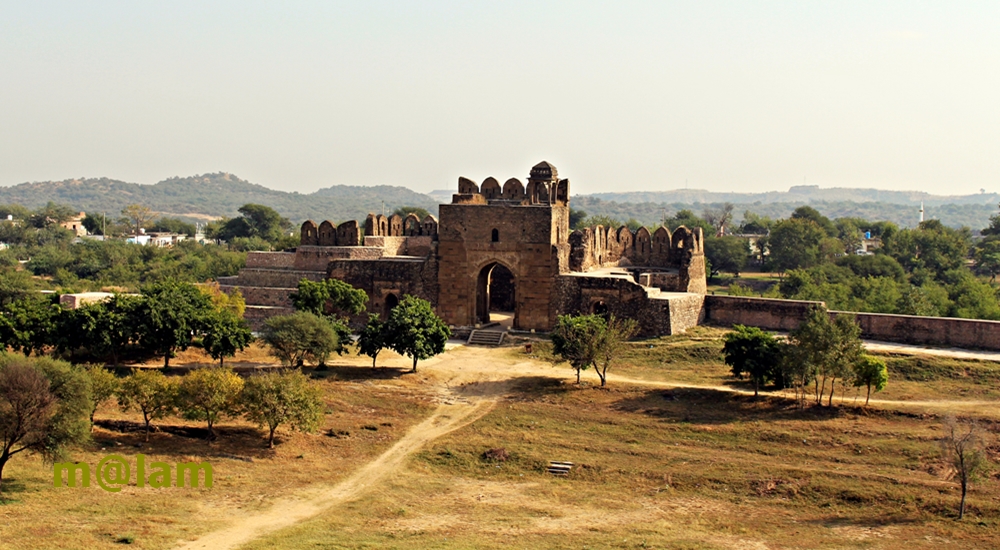
Rohtas Fort: History and Architecture at Heights Rohtas Fort, also known as Qila Rohtas, stands as an iconic symbol of military ingenuity and architectural brilliance in Punjab, Pakistan. Nestled in the Tilla Jogian Range on the Pothohar Plateau, this UNESCO World Heritage Site (since 1997) is a masterpiece of early Muslim military architecture in Central and South Asia. Its robust design, sprawling walls, and intricate gateways have earned it a place among the most remarkable historical sites in the region. Location and Setting Strategically positioned 91.5 meters (300 feet) above its surroundings, Rohtas Fort is perched on a hill overlooking the confluence of the Kahān River and the seasonal Parnal Khas stream. The fort rises to an elevation of 819 meters (2,687 feet) above sea level, covering an impressive 70 hectares (170 acres). Just 16 kilometers northwest of Jhelum, it lies near the historic Grand Trunk Road, a vital trade route connecting Afghanistan to the plains of Punjab. A Glimpse into History The Vision of Sher Shah Suri (Sur Period) Following his victory over Mughal Emperor Humayun in 1541, Sher Shah Suri commissioned the construction of Rohtas Fort to consolidate his power and thwart a potential Mughal resurgence. Tasked with suppressing the pro-Mughal Ghakkar tribe, the fort was designed to be both an impregnable fortress and a statement of authority. Despite initial resistance from the local populace, construction progressed under the supervision of Todar Mal, a Punjabi Khatri minister. The fort’s architectural blend of Persian, Afghan, and local influences reflects Sher Shah’s vision for an enduring legacy. Mughal Period After Sher Shah’s death, the fort’s strategic significance dwindled. It was ceded to Humayun in 1555, who used it briefly before his empire shifted focus to more ornate structures like the nearby Attock Fort. While Emperor Akbar and Jahangir rested at Rohtas during their travels, its plain military style was less appealing to the Mughals, who preferred structures adorned with gardens and elaborate designs. Sikh Empire and British Era In 1825, the fort fell under the control of the Sikh Empire, with Gurmukh Singh Lamba capturing it from Nur Khan, a Ghakkar chief. It served as an administrative hub during the Sikh reign until the British annexed the Punjab region in 1849. Architectural Marvels of Rohtas Fort Main Fortifications The fort’s defensive walls stretch over 4 kilometers, enclosing an area capable of housing 30,000 soldiers. Rising between 10 to 18 meters in height and 10 to 13 meters in thickness, the walls feature 68 bastions, 1,900 battlements, and 12 monumental trap gates. Inner Citadel A secondary wall 533 meters long divides the inner citadel from the rest of the fort. Structures like Haveli Man Singh, Shahi Mosque, Baolis (stepped wells), and the Rani Mahal add historical depth to the citadel’s interior. Notable Structures Haveli Man Singh Constructed between 1550 and 1614, this prominent structure reflects Hindu architectural elements and offers commanding views of the surroundings. Rani Mahal The Rani Mahal, near Haveli Man Singh, was once a four-room structure, now reduced to a single room with visible foundations. Shahi Mosque Located near the Kabuli Gate, this modest yet ornate mosque is one of the most decorated buildings within the fort. Baolis (Stepped Wells) The fort features three Baolis—Main Baoli, Shahi Baoli, and Sar Gate Baoli—essential for water storage during sieges. The Gates of Rohtas FortRohtas Fort is renowned for its 12 intricately designed gates, each with unique historical and architectural significance: Sohail Gate: Named after Saint Sohail Bukhari, this gate showcases exemplary masonry from Sher Shah’s time. Shah Chandwali Gate: Honoring Saint Shah Chandwali, this gate connects the citadel to the main fort. Kabuli Gate: Facing west towards Kabul, this double gate opens to a width of 3.15 meters. Shishi Gate: Distinguished by its glazed tile embellishments, representing an early example of this technique. Langar Khani Gate: A double gate leading to a Langar Khana (Mess hall or Canteen). Talaqi Gate: Named after “Talaq” (divorce), as legend has it Prince Sabir Suri’s entry through this gate was ill-fated. Mori or Kashmiri Gate: Opening northward, it’s aptly named for its orientation towards Kashmir. Khwas Khani Gate: An ode to Khwas Khan, one of Sher Shah Suri’s most prominent generals. Gatali Gate: Facing the village of Gatali, it served as a vital crossing point for the River Jhelum to the Kashmir Valley. Tulla Mori Gate: Located on the eastern side, it’s more of an entrance than a gate, featuring a bastion. Pipalwala Gate: Resembling the Tulla Mori Gate, it’s a small entrance. Sar Gate: Known as “Sar (water),” this gate includes a small entrance with a bastion and a Baoli adjacent to it. Modern-Day Preservation Despite centuries of exposure, much of Rohtas Fort remains well-preserved. Restoration efforts have focused on key areas like the Chandwali Gate, which was recently rebuilt. However, natural erosion and neglect have caused some damage, such as the partial collapse of the Talaqi and Gatali Gates. Visitor Information Easily accessible at 16km northwest of Jhelum, and 8 km south of Grand Trunk Road makes it a convenient stop for travelers exploring the region. Rohtas Fort is a must-visit for history enthusiasts and architecture lovers. Plan Your Visit Rohtas Fort’s rich history and breathtaking vistas make it a destination that blends culture, history, and natural beauty. Whether you’re tracing the footsteps of emperors or marveling at ancient craftsmanship, the fort offers an unforgettable experience. Nearby Attractions Maqbara Khair un Nisa Tilla Jogian Forts in Pakistan Baltit Fort Altit Fort Red Fort Muzaffarabad Lahore Fort Kot Diji Fort Derawar Fort

Scroll to Top